Custom software for logistics and transport.
For transport, forwarding and warehousing, where every order, trip and consignment note has to be right.
No obligation · six questions · reply within one to two working days
Who we build for
- Road transport
- Forwarding and customs
- Warehousing and 3PL
- Intermodal
What is happening.
What is changing in logistics and transport.
- 01
A charge per kilometre
Since 1 July 2026, you pay per kilometre for lorries over 3,500 kg. That has to go into your rates, and you want to see what it costs per trip and per customer.
- 02
Freight data in advance and digital
ICS2 and NCTS ask for data before arrival, and from 2027 authorities must accept digital freight information. Shippers still send PDFs, emails or paper.
- 03
Rest periods on the tachograph
The smart tachograph records rest periods, cabotage and return trips. A schedule that does not take them into account catches up with you at a roadside check.
- 04
Status queries by phone
Planners are scarce, and customers call and email to ask where their shipment is. Every call takes a planner away from their work.
Where it can be better.
Six processes from day-to-day operations in transport and logistics.
- How it works now
- Transport orders, packing lists and invoices arrive by email or PDF and are retyped into the TMS.
- What could be better
- Less manual work each day, and errors caught before the customer sees them.
Demo company
- Orders
- Documents
- Customers
- Exceptions
Demo company › Orders
- Today
- Imported
- To check
- In the TMS
- Orders today
- 64
- Straight into the TMS
- 58
- To check
- 3
The order says ten pallets, the packing list eleven. Order prepared for eleven, with both PDFs attached.The order processor decides on anything that deviates.
Release orderAdjustThe order says ten pallets, the packing list eleven. Order prepared for eleven, with both PDFs attached.The order processor decides on anything that deviates.
Release orderAdjustExample. Demo company; names and figures are fictitious.
All processesThe system proposes. You decide.
The system reads, checks and prepares. A person decides what happens.
| Process | What the system does | Who decides |
|---|---|---|
| Order intake | What the system does: Instructions from email, PDF and EDI become orders in the TMS. Anything unusual is passed to you. | Who decides: The order processor decides on anything that deviates. |
| Trip planning | What the system does: Orders on lorries and drivers, with drivers’ hours and what the planner knows about each customer. In one schedule, not in a spreadsheet alongside. | Who decides: The planner approves every change. |
| Trip costing | What the system does: Each trip with its road charge, waiting time and fuel. You see what a trip earned, per customer and route. | Who decides: The commercial manager decides on the rate. |
| Customs and documents | What the system does: Data from invoices and packing lists is pre-filled in the declaration. With a suggested HS code. | Who decides: The customs declarant decides on the code and submits. |
| Warehouse and VAS | What the system does: Activities from the WMS next to each customer’s contract. So you invoice what you did, without manual work. | Who decides: The account manager decides on the rate. |
| Status queries | What the system does: Customers see for themselves where their shipment is. Routine questions get an answer with the source attached; the rest goes to the planner. | Who decides: The planner decides what the customer is told. |
Compliance you can prove.
What the rules in transport and logistics ask, and what the system records.
| Rule | The inspector asks | The system records |
|---|---|---|
| Vrachtwagenheffing (Dutch HGV road charge)Since 1 July 2026, a per-km charge for lorries over 3,500 kg. | Kilometres per vehicle | Trips per vehicle |
| Drivers’ hoursRest periods, cabotage and the return obligation, checked via the smart tachograph. | Rest times and cabotage | Planning alongside tachograph data |
| ICS2 and NCTSSafety and security data before arrival, and digital transit documents. | Safety and security data before arrival | Shipment data and filing |
| eFTI and eCMRDigital freight information: authorities must accept it from around July 2027. | Digital freight information | Consignment note per shipment |
| For every sector | ||
| GDPR | Who processes personal data, and where | Data processing agreement, EU hosting with ISO 27001-certified partners |
| AI Act | Human oversight of AI | Every proposal with who approved it |
Start here.
One process, one prototype. Then you decide.
Start with the orders and freight documents you now retype, or with costing per trip.
- Step 01
Conversation
A process map
- Step 02
Prototype
A prototype
- Step 03
Build
A go or no-go per phase
- Step 04
In operation
Your code, your data
Systems you may already use
- Transpas
- MendriX
- Boltrics 3PL Dynamics
- ORTEC
- Portbase
- Stream
- Softpak
- Exact
- AFAS
We connect to what is there, or build alongside it where the package is too heavy or too rigid.
Where we are not the right fit
We do not replace your TMS or WMS: what a package does well stays there. We build alongside it, for intake, costing and invoicing.
Questions.
About costs, time, integrations and ownership.
What does it cost?
Most systems we build cost between €10,000 and €40,000, one-off. Support is about 3 to 5% of that, per month. After the prototype you get a fixed price, before you sign anything.
How long does it take?
We set that after the prototype, per phase. We do not give a timeframe before then.
How much of our time does it take?
One owner who makes the decisions, and a few users who review and test during the build. We agree the exact amount per project.
Does it connect to our ERP and Microsoft?
Yes. Users sign in with their own Microsoft account and MFA. We set out in the proposal which ERP and file integrations are included.
Who owns the software?
You do. The rights transfer per phase, once that phase is paid. No licence.
Where is it hosted?
In the EU, encrypted: EU hosting with ISO 27001-certified partners.
Who maintains it?
We do, under an SLA. Or you do: the documentation is written for that.
People


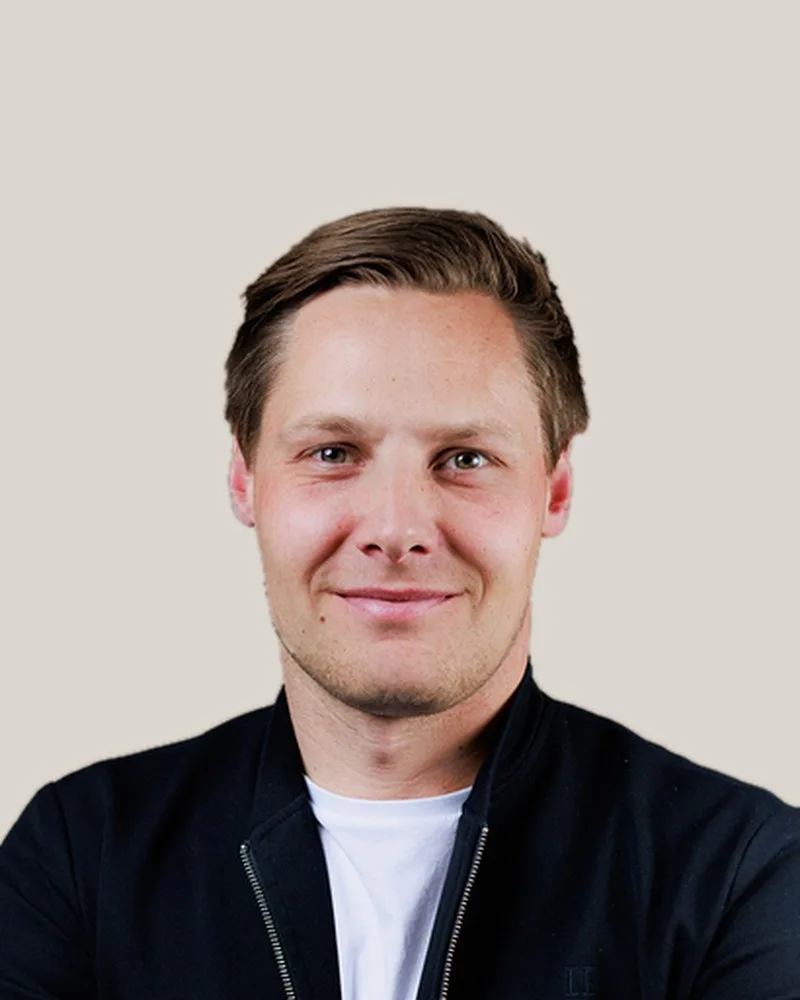
You talk to the people who build it: Jelle, Mike and Jeroen. No account manager, no middleman.
About usShow us one process that could be lighter.
No obligation · six questions · reply within one to two working days. Or get in touch