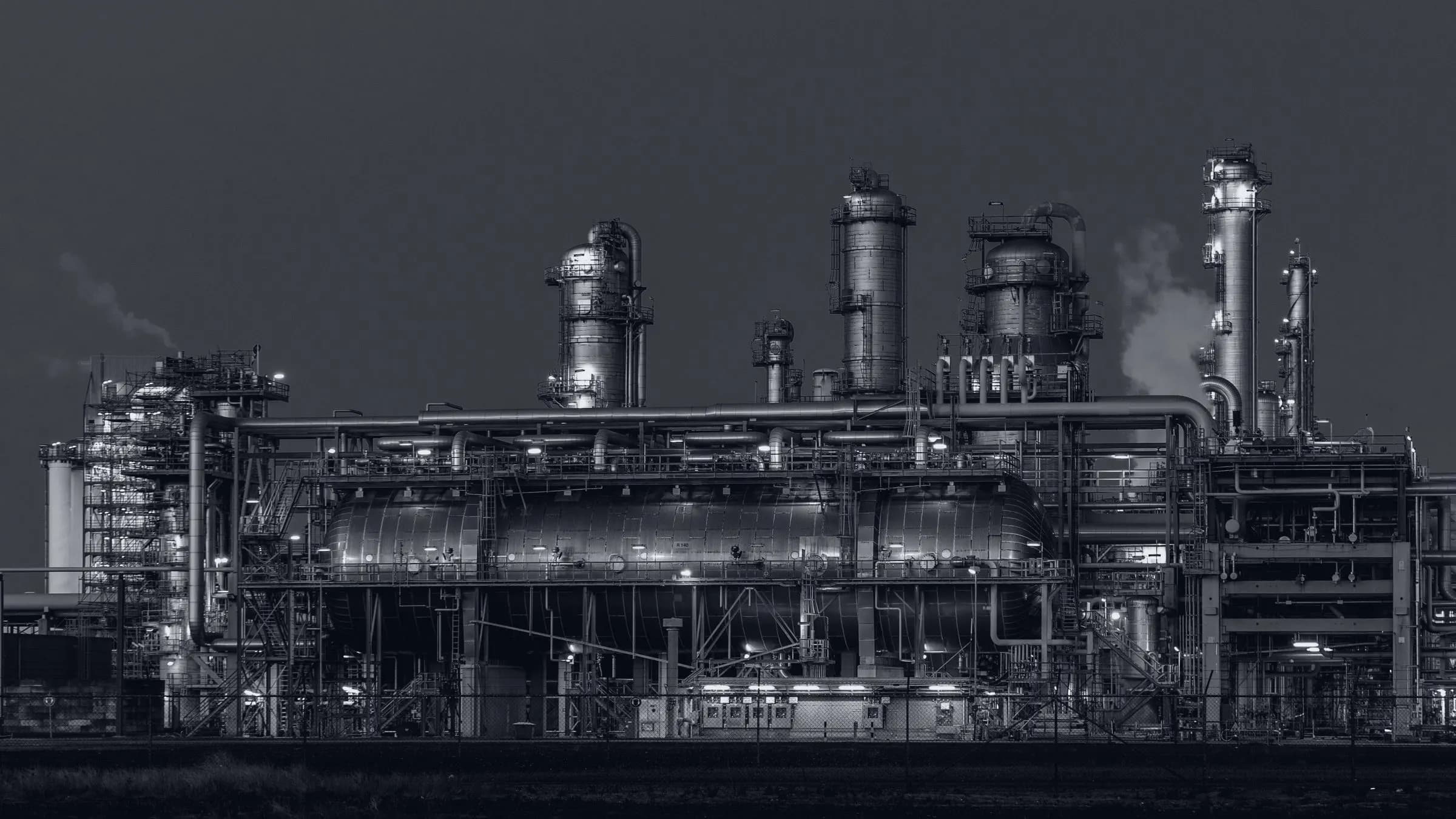
Custom software for energy and chemicals.
For terminals, chemicals, refining, bunkering and offshore wind, where safety, permits and regulatory oversight shape the work.
No obligation · six questions · reply within one to two working days
Who we build for
- Tank storage, terminals and bunkering
- Chemicals and refining
- Offshore wind O&M
- Energy and grid contractors
What is happening.
What is changing in energy and chemicals.
- 01
Reporting within 24 hours
The Cyberbeveiligingswet (Dutch NIS2 Act) has applied since 15 August 2026: an early warning within 24 hours, the full notification within 72 hours. You must be able to show processes, roles and a log.
- 02
Inspections ask for evidence
A BRZO inspection (Dutch Major Accident Hazards Decree) asks for evidence of permits, changes, incidents and follow-up. That evidence is now spread across paper, email and separate lists.
- 03
A turnaround with hundreds of contractors
In a turnaround, hundreds of contractors arrive within a few weeks. Certificates, access and permits must all be in place at once, and you see overruns late.
- 04
Changes with many approvals
Every change to an installation needs a review and approval from several people. You want to see at a glance who still has to sign and what is open.
Where it can be better.
Six processes from day-to-day operations in the energy and chemicals sector.
- How it works now
- Permits are requested, checked and signed off on paper. Energy sources are isolated from a list.
- What could be better
- Seeing at a glance what is running and where it clashes, with certificates checked without manual work.
Demo company
- Permits
- LOTO
- Zones
- Gas tests
- Archive
Demo company › Permits
- Today
- In progress
- Awaiting issue
- Closed
- Open today
- 12
- LOTO active
- 5
- Blocked
- 2
2322 and 2318 are both hot work in zone B, eight metres apart. Proposal: 2322 starts at 14:00, after 2318 is closed.The permit issuer reviews and issues.
Confirm rescheduleAdjust2322 and 2318 are both hot work in zone B, eight metres apart. Proposal: 2322 starts at 14:00, after 2318 is closed.The permit issuer reviews and issues.
Confirm rescheduleAdjustExample. Demo company; names and figures are fictitious.
All processesThe system proposes. You decide.
The system reads, checks and prepares. A person decides what happens.
| Process | What the system does | Who decides |
|---|---|---|
| Work permits and LOTO | What the system does: Every permit in digital form, with the LOTO list attached. You see what is running in each zone, and where it clashes. | Who decides: The permit issuer reviews and issues. |
| Turnaround or shutdown | What the system does: Contractors, certificates and permits per work package, next to the turnaround schedule. You see overruns while you can still adjust. | Who decides: The turnaround coordinator decides whether the package moves. |
| Admitting contractors | What the system does: The gate sees for each person whether VCA, GWO and site induction are valid. And the evacuation list is always up to date. | Who decides: The gate officer admits or turns people away. |
| TRA and LMRA | What the system does: The TRA starts from what is already known about the installation. Including what went wrong before. | Who decides: The work planner finalises the TRA; the crew does the LMRA. |
| Management of Change | What the system does: Every change with its review, approvals and actions in one place. You see who still has to sign and what is open. | Who decides: The MoC coordinator decides whether to extend or reverse it. |
| Jetty planning and inventory | What the system does: Line-up, jetties and tanks in one schedule. You see a difference between measurement and paperwork during discharge, not afterwards. | Who decides: The terminal planner decides on the line-up. |
Compliance you can prove.
What the rules in energy and chemicals ask, and what the system records.
| Rule | The inspector asks | The system records |
|---|---|---|
| BRZO (Dutch Major Accident Hazards Decree)Sites with large quantities of hazardous substances must show that their safety management works. | Proof that safety management works | Permits, MoC and incidents |
| Cyberbeveiligingswet (Dutch NIS2 Act)Since 15 August 2026, a duty of care and a duty to report for energy and chemicals: an early warning within 24 hours, the full notification within 72 hours. | Duty of care, report within 24 and 72 hours | Access and changes per user |
| EU ETS and CBAMReport and pay for emissions; CBAM has been in its definitive phase since 1 January 2026. | Emissions per installation and import | Measurements with source and date |
| NEN 3140, VCA and GWOAnyone working on installations must be qualified and certified. | Who is qualified for which work | Qualification per person and task |
| For every sector | ||
| GDPR | Who processes personal data, and where | Data processing agreement, EU hosting with ISO 27001-certified partners |
| AI Act | Human oversight of AI | Every proposal with who approved it |
Start here.
One process, one prototype. Then you decide.
Start with your work permits and with registering contractors for a turnaround.
- Step 01
Conversation
A process map
- Step 02
Prototype
A prototype
- Step 03
Build
A go or no-go per phase
- Step 04
In operation
Your code, your data
Systems you may already use
- IFS Ultimo
- SAP S/4HANA (PM)
- IBM Maximo
- AVEVA PI
- Primavera P6
- KLIC
We connect to what is there, or build alongside it where the package is too heavy or too rigid.
Where we are not the right fit
Large operators with their own platform team usually do not need us. We start with one site or one process, for terminals, chemical companies, bunker suppliers and contractors.
Questions.
About costs, time, integrations and ownership.
What does it cost?
Most systems we build cost between €10,000 and €40,000, one-off. Support is about 3 to 5% of that, per month. After the prototype you get a fixed price, before you sign anything.
How long does it take?
We set that after the prototype, per phase. We do not give a timeframe before then.
How much of our time does it take?
One owner who makes the decisions, and a few users who review and test during the build. We agree the exact amount per project.
Does it connect to our ERP and Microsoft?
Yes. Users sign in with their own Microsoft account and MFA. We set out in the proposal which ERP and file integrations are included.
Who owns the software?
You do. The rights transfer per phase, once that phase is paid. No licence.
Where is it hosted?
In the EU, encrypted: EU hosting with ISO 27001-certified partners.
Who maintains it?
We do, under an SLA. Or you do: the documentation is written for that.
People
You talk to the people who build it: Jelle, Mike and Jeroen. No account manager, no middleman.
About usShow us one process that could be lighter.
No obligation · six questions · reply within one to two working days. Or get in touch